This came my way earlier today, thought it relates in some ways, potentially at least, to our own larger project (Location Relation Notation, re: Essex and shipbuilding at Essex) —
A pocket publication and extensive website dedicated to creative experiences with travel.
The “+1” for any trip in Japan is the unexpected location that makes the trip extra special, from a backstreet bookstore to a mountain hike into inspiring scenery.
Ian Lynam Design designed the gatefold-cover book and website, which you can see here.
The Essex Historical Society and Shipbuilding Museum Presents:
The Evelina Goulart Symposium : Managing a Ninety-Ton Historical Artifact
A Four-Part Symposium
On the 20th Anniversary of Bringing the Evelina M. Goulart Home
Produced by: Barry O’Brien
The Evelina M. Goulart, a fishing schooner built in at the A.D. Story Shipyard in Essex, Massachusetts in 1927, is one of seven remaining Essex-built schooners in existence. Presented on March 4, 2010, April 1, 2010, April 29, 2010 and May 27, 2010
Town of Essex, T.O.H.P. Burnham Library
245 Western Ave, Essex, Massachusetts 01929 (but call to check on location)
Phone: (978) 768-7410
e-mail: mes@essexpl.org website
Google Books, Advanced Search
here
use combination of "exact phrase" and "all the words," and be sure to specify pre-1923. This is a very powerful tool.
We're looking forward to presentations of what we've found for our larger, final project — sources that interest us, stories, themes — and ideas we might have about tools. Each presentation might take 10 minutes or so.
Your presentations should have visual support in the form of slides — powerpoint or equivalent, or images on the blog, something that is is coherent and that gives enough detail that we can usefully respond to it. We're interested in the story and mobile app potential of your materials.
We will decide on assembling teams, and what teams might mean, once we've got a better sense of where everyone is headed.
A Practical Course in Wooden Boat and Ship Building :
The Fundamental Principles and Practical Methods Described in Detail, Especially Written for Carpenters and Other Woodworkers who Desire to Engage in Boat Or Ship Building, and as a Text-book for Schools
Richard Montgomery Van Gaasbeek (1919) —
opens to a chapter on tools here
Fig. 41, Practice Caulking (from Practical Course), here. same image, earlier (1918, Cornell) copy at archive.org.
also
The Key to Steel and Wood Shipbuilding : With Valuable Aids and Information
Edwin Ellis Gaylord (1918) here
and the conclusion, at page 64 — After reading this booklet through carefully, during the noon hour or after working hours, take it onto the ship and locate each part. You will thus quickly get the whole subject fixed in your memory. Until you have learned the names of all the parts mentioned, carry the booklet in your pocket so that you can refer to it when necessary.
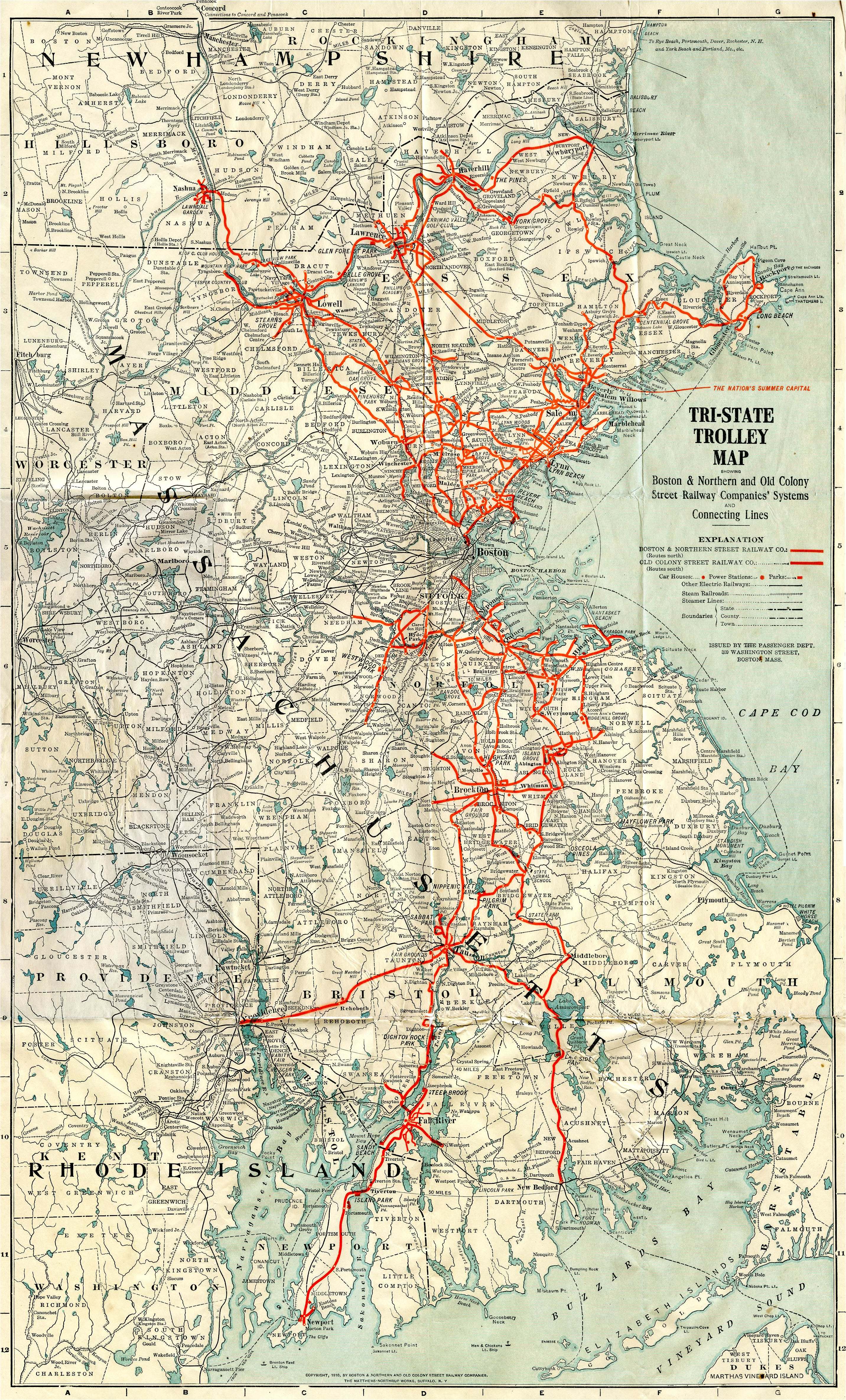
via The trolley comes to Ipswich, June 26, 1896
thanks to help (with search terms) of librarian at Beverly Public Library
(maybe can be helpful to Alexandra in her info gathering)
so there were two lines serving/passing through Exxex:
trolley line passing through Essex on way to Gloucester and other points on Cape Ann
how did people get around before rail? were they more likely to stay put?
will watch for more on transportation; again, reference librarian at Beverly Public Library was helpful. there may be materials in their "Beverly" (local history) room that is useful. It is not limited to Beverly, and is pretty good on the entire North Shore in particular.
I mentioned "maintenance art" during our discussion of things that are broken, yesterday. Thought I would list some links on the subject. The most recent have to do with the artist Mierle Laderman Ukeles, who has a show at the Queens Museum (ending this Sunday 19 February).
Andrew Russell and Lee Vissell, Hail the maintainers : Capitalism excels at innovation but is failing at maintenance, and for most lives it is maintenance that matters more Aeon, 7 April 2016, and
Things that are broken as a theme relates to ruins (when is a building at its ripest? some architects have designed structures with their ruination, a thousand years hence, in mind). What gets broken? connections. relationships. hearts —
Sheila Marikar, "What Becomes of the Brokenhearteds’ Stuff" (The New York Times, 6-7 July 2016), on the Museum of Broken Relationships in Los Angeles.
And then there's the vast literature on and of failure. and ruins. and more on failure (all in our library!)
These are the kinds of detours — and concepts — that might animate and drive our Location Notation Relation inquiries.
I am a frequent user of the Google Books Advanced Search tool in my own work, and did a quick search for Wenonah Stevens Abbott, not as author but as an "exact phrase" in books and journals published before December 1923.
"United : An occult sketch," Mind 1:6 (March 1898)
: 351-354 (don't miss title page of this issue)
"What our sisters are doing : Work of the Women's National Socialist Union," The National Magazine : An Illustrated Monthly 17:1 (October 1902) : 39-40
I would only add that much of the pre-1923 material that is visible to users in the United States, is not visible elsewhere (including Canada and Europe). Where it is important that the source be accessible outside the U.S., it's good to try to find it via archive.org.
We will also discuss our respective team's projects for the second (ARIS-based) project.
Jack (JD) and Li Yun — things that are broken
Alexandra and Sarah — things that are broken
Emma, Jax and Kelven — things that are lost (Central Cemetery)
We will also meet with librarian Cheri Coe to get a sense of where useful resources might be found.
Wednesday 8 February
Our guest on this day Andrew Sliwinski, a Research Scientist in the LEGO Learning Laboratory at the MIT Media Lab where he explores the intersections between learning, creativity, and technology. From what I (John) have seen of his work, Andrew is interested in the creation of means by which people, of all ages, can engage with content in a significant and meaningful way.
Among his active research projects is Scratch – an online community and tool for kids to explore their creativity through computing which reaches over one hundred million children every year. Prior to joining MIT, Andrew served as the Director of Learning Research at the Mozilla Foundation and co-founded DIY.org. He has served as an advisor to the Chicago Public Library, LEGO Foundation, and The Aspen Institute.
An advocate of open design and engineering practices, Andrew contributes to various open source projects and has released over 40 individual software libraries. Most notable amongst his contributions have been projects related to natural language processing (NLP), machine learning, signal processing, and computational creativity.
As a designer and engineer, Andrew has worked with various organizations during his career including: General Electric, Adidas, Hewlett-Packard, Toyota, Universal Music Group, and JetBlue. His work as a creative technologist has been displayed in The Museum of Science & Industry in Chicago, The Museum of Modern Art in New York, and Carnegie Hall.
Jack (JD) and Li Yun Alexandra and Sarah Emma, Jax and Kelven
Four theme ideas —
things that are broken things that are lost (vestiges of a vanished time / Beverly) vernacular (untrained) lettering, messages, signs, marks the Beverly waterfront (Bass River around to Dane Beach and beyond)
We will go through the ARIS tutorial on Monday, with various adjustments, augmentations. This is a three or four week exercise. ARIS can be found here. Click on Launch the 2.0 Editor, sign up (user name and password).
Wednesday —
We travel to the Essex Shipbuilding Museum and environs. Our bus/van leaves from the front of Hardie at 11:30am. Be early. Bring lunch. Dress warm. Boots advisable. We'll be back by 3:10.
Here are "trigger" images, being coded trees on the hillside behind Hardie, starting with lower trees (in vicinity of dumpster), and moving up to the right, and then left descending along the chainlink fence.
This is an experiment, and is not fully functioning at present.
afterthoughts —
believe that the bark patterns themselves may be sufficient, to differentiate 10-12 triggers. If so — will test — could get by with only a single blue dot (just to indicate center of a trigger area); alternatively, could use circular-shaped metal labels (with hole for pin or nail), as suggested by Chelsea, or some other more permanent/dependable mark that is immune to weather.
Thinking, for example, of numbered nails (nails with figures on them) — date nails letter nails
John McVey at aurasma : asfaltics
01
02
03
04
aside
I've removed images 5-11, because I've not yet created "auras" for them. One of my primary texts is Thomas A. Clark, his In Praise of Walking. Text (marred by some typos) here.
This image, at the gazebo on Beverly Commons, loads an overlay which, if clicked, brings viewer to an external website.
I'll need to experiment further with the overlay "actions" : it was not intuitively obvious how to make it work. I did notice that I needed to change the order (by selecting and moving within the aurasma editing space) one of the two overlay boxes.
one of a series of experiments, to test how well a 3D object can work as a trigger. Here is same doorknob, three different orientations. Aurasma sees them as three different triggers when viewed close (on site, in library). Chelsea's iPhone read them as one trigger, when viewed from further away.
to view the below, may need to point your smartphone or tablet away from each image, before focusing in on the next one. so that it can "refresh."
note: thanks Chelsea for advice on steps to make "private" auras "public;" her instructions appear below, following the ten images.
Beauty – be not caused – It is –
Chase it, and it ceases –
Chase it not, and it abides –
Overtake the Creases
In the Meadow – when the Wind
Runs his fingers thro’ it –
Deity will see to it
That You never do it –
— Emily Dickinson
01
02
03
04
05
06
07
08
09
10
on making "private" auras "public" —
from the Aurasma Studio web interface:
go into the "my auras" area and select one aura at a time
in the upper right hand corner select "edit"
now you should be in the editor interface where you set your trigger and overlay; click the "next" buttons until you reach the screen where you can rename your aura
click "share" (in the same row as "next" button)
your aura should now be public
my source —
gutter between pp 280-281, and left edge of two halftone photographs (inverted)
Amos Everett Jewett, “The Tidal Marshes of Rowley and Vicinity with an Account of the Old Time Methods of Marshing,” Essex Institute Historical Collections 85 (1949): 272-291.
Getting started with Augmented Reality
This course will teach you the basics of developing mobile applications using Mixed and Augmented Reality (MAR and AR) technologies. Through hands-on projects, you’ll learn practical techniques to rapidly and easily prototype three different applications for Android smartphones and tablets...
Aurasma Dual interface AR system, consisting of an app and online platform. Involves trigger images, and overlays. See "help" for brief tutorial.
ARIS
Open source online tool for creating location-based mobile experiences.
NeuralTalk and Walk from Kyle McDonald on Vimeo.
Andrej Karpathy's "NeuralTalk" code slightly modified to run from a webcam feed. I recorded this live while walking near the bridge at Damstraat and Oudezijds Voorburgwal in Amsterdam. NeuralTalk is trained on the MS COCO dataset, which guides the kind of captions that are generated mscoco.org/dataset/#captions-challenge2015 MS COCO contains 100k image-caption pairs covering a wide variety of situations. But in a brief walk, you will really only run into a few of those situations. note : fascinating for the auto-generated (and sometimes hilarious) captions
Barbara Bloom, The Weather
not augmented reality per se but related — Sighted people can see the illusionary photograph (though not how the illusion is accomplished), but most will only be able to squint and guess at the too-small text. The blind will be able to read the text (the plexiglass is cut away over the Braille so it can be touched), but unable to see the photograph. The one thing that is clear to all is that everyone is blinded.
Benny Nemerofsky Ramsay Spins a Yarn
POLIN Museum of the History of Polish Jews, Warsaw, Permanent Display
R.M. VAUGHAN. Canadian Art. May 11, 2015
Benny Nemerofsky Ramsay, The Muranów Lily. 16 February – 8 March 2015
POLIN Museum of the History of Polish Jews note : The Muranów Lily is the audio guide
Town of Essex Historic Properties Survey Plan (January 2014) includes archeological summary, bibliography, and several appendices including the Reconnaissance Survey Town Report for Essex (1985) PDF
Historic USGS Maps of New England & New York Ipswich, MA Quadrangle / USGS 7.5 Minute Series Essex at southeast corner
Dawn Robertson and Kurt A. Wilhelm, Essex (Arcadia Publishing, Images of America series, 2010)
Courtney Ellis Peckham, Essex Shipbuilding (Arcadia Publishing, Images of America series, 2002)
Robert W. Hill, "Our Coastal Pioneers," Essex Institute Historical Collections 78 (1942): 24-40. on the building of fishing (and other) boats at Essex
Amos Everett Jewett, “The Tidal Marshes of Rowley and Vicinity with an Account of the Old Time Methods of Marshing,” Essex Institute Historical Collections 85 (1949): 272-291. at Beverly Public Library
John Stilgoe, "Salt Marshes" in his Alongshore (1994) : 101-130
John Stilgoe, What is Landscape? (2015)
John Stilgoe, Shallow-Water Dictionary (Exact Change, 1990)